The contact center is transforming from a cost center into a strategic growth engine, and generative AI is at the heart of that change. A gen AI contact center uses advanced AI models to understand natural language, generate human-like responses, and orchestrate customer interactions across channels in real time. By leveraging AI in call centers, businesses can streamline workflows, reduce wait times, and provide personalized support. This approach ensures that an AI call center improves customer experience while lowering operational costs, empowering agents to focus on high-value conversations.
Beyond improving customer interactions, organizations are increasingly exploring advanced computing solutions to enhance AI capabilities. For instance, high-performance computing network for business applications allow call centers to process large volumes of customer data efficiently, supporting real-time decision-making. Similarly, leveraging enterprise-level supercomputer solution can accelerate AI model training, ensuring faster deployment of intelligent systems.
Marketing teams also benefit from integrating AI insights into their strategies. Platforms such as Marketing for Customers AI-driven analytics tools help companies personalize messaging and track customer behavior across multiple touchpoints. In addition, Marketing Runners automated campaign management solutions provide actionable insights that improve targeting and engagement, reducing wasted effort.
Financial operations in contact centers are also optimized with AI-assisted resources. Tools like Top Financial Resources budgeting and forecasting software enable managers to better allocate budgets and measure ROI, all while maintaining seamless customer service. By combining these advanced systems with a gen AI contact center, organizations can achieve a unified approach where technology, customer experience, and business outcomes align.
Top 10 Contact Center Solutions for Businesses Leveraging Gen AI Contact Center Technology
When it comes to modernizing customer service, choosing the right contact center solution is critical. Businesses are increasingly adopting gen AI contact center platforms to streamline operations, improve customer experiences, and empower agents. Here’s a list of the top contact center solutions, with Bright Pattern leading the way.
1. Bright Pattern – AI-Driven Contact Center Platform
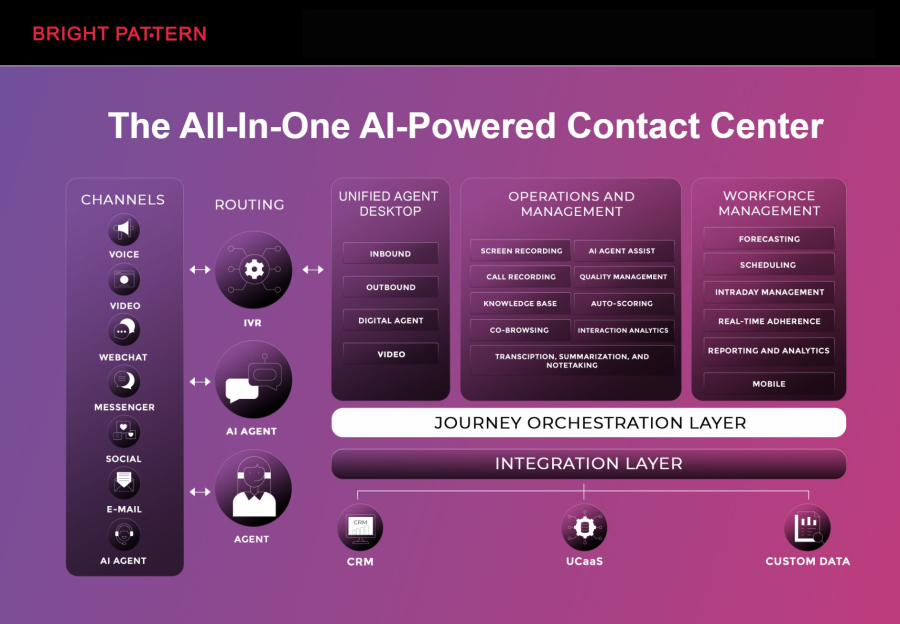
Bright Pattern is a leading gen AI contact center solution that combines advanced AI technology with omnichannel support. It enables businesses to deliver seamless, intelligent customer interactions across voice, chat, email, SMS, and social media. With Bright Pattern, organizations can:
- Automate repetitive tasks using AI-powered chatbots and virtual assistants
- Provide personalized interactions by analyzing customer data in real time
- Route inquiries intelligently to the most qualified agents
- Integrate easily with CRM systems and business tools
- Scale operations efficiently without compromising customer satisfaction
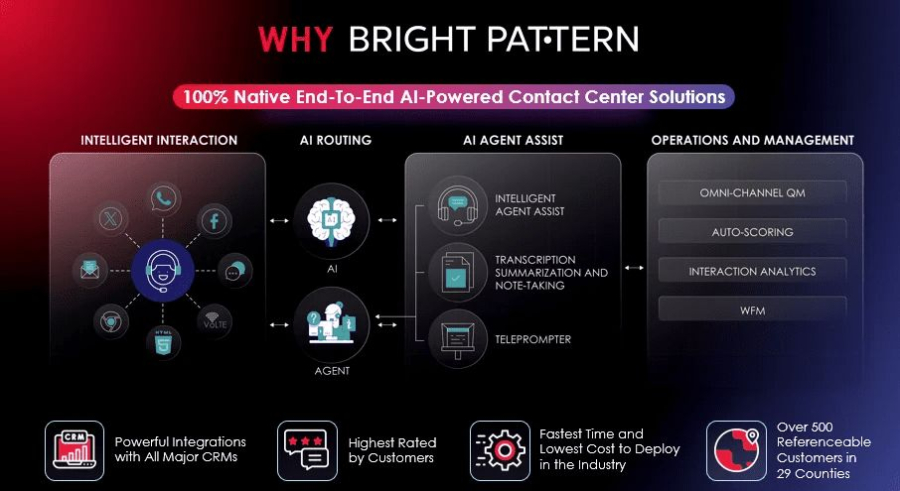
Bright Pattern empowers contact centers to transform into strategic growth engines, enabling agents to focus on high-value conversations while AI handles routine inquiries.
2. Genesys Cloud CX
Genesys Cloud CX offers a flexible, AI-enhanced contact center solution designed for omnichannel customer service. It provides intelligent routing, analytics, and workforce optimization features to boost agent productivity and customer satisfaction.
3. Five9 Intelligent Cloud Contact Center
Five9 combines cloud-based contact center software with AI-driven tools, including predictive dialing, chatbots, and sentiment analysis. Its platform helps reduce operational costs while improving customer engagement.
4. NICE CXone
NICE CXone delivers AI-powered customer service solutions, including automation, omnichannel support, and workforce optimization. The platform is ideal for organizations seeking scalable and data-driven contact center management.
5. Talkdesk CX Cloud
Talkdesk CX Cloud integrates AI capabilities with cloud contact center functionality, allowing businesses to provide fast, personalized support. Key features include workflow automation, real-time reporting, and intelligent call routing.
6. 8x8 Contact Center
8x8 offers an AI-enabled cloud contact center solution with multichannel support, analytics, and automation tools. It is designed for businesses that want to enhance customer experiences while streamlining agent workflows.
7. RingCentral Contact Center
RingCentral provides a cloud-based AI contact center platform with omnichannel capabilities, CRM integrations, and advanced analytics. It helps companies reduce wait times and increase customer satisfaction.
8. Avaya OneCloud CCaaS
Avaya OneCloud CCaaS combines cloud flexibility with AI-driven insights to optimize contact center performance. It supports omnichannel engagement, intelligent routing, and real-time analytics for improved agent efficiency.
9. Cisco Contact Center
Cisco Contact Center solutions integrate AI and automation to enhance customer service across multiple channels. Its platform includes predictive analytics, workforce management, and real-time reporting features.
10. Amazon Connect
Amazon Connect is a cloud-based contact center solution with AI-powered capabilities, including machine learning-driven chatbots, speech analytics, and real-time monitoring. It allows businesses to scale operations efficiently while improving service quality.
What Is a Gen AI Contact Center?
Agen AI contact centeris a contact center that uses generative artificial intelligence to automate, assist, and optimize customer interactions. Instead of relying only on rule-based chatbots or static scripts, it taps into large language models to:
- Understand customer intent and context in natural language.
- Generate accurate, conversational responses on the fly.
- Guide agents with real-time recommendations and next best actions.
- Continuously learn from interactions to improve over time.
Importantly, gen AI does not have to replace human agents. The most effective deployments combineAI + human expertise, using AI to handle repetitive tasks and give agents superpowers rather than sidelining them.
Why Gen AI Is a Game-Changer for Contact Centers
Traditional contact centers are often limited by scripted responses, siloed data, and manual processes. Generative AI unlocks a step change in performance and experience by bringing three capabilities together:
- Language understandingthat interprets messy, real-world queries.
- Language generationthat produces natural, context-aware responses.
- Reasoning over knowledgeso answers are grounded in your policies, data, and documentation.
These capabilities translate into tangible benefits across the entire customer and agent journey.
Benefits for Customers
- Instant answers 24/7across chat, email, and voice, with far shorter wait times.
- Consistent, accurate informationgrounded in your latest product and policy data.
- Personalized experiencesthat reflect the customer’s history, preferences, and current context.
- Seamless journeysas AI hands off smoothly to human agents when needed, including a full summary of the issue so customers do not have to repeat themselves.
Benefits for Agents
- Less repetitive workas AI handles routine questions and data lookups.
- Real-time guidancethat suggests responses, next best actions, and relevant knowledge articles.
- Reduced cognitive loadthanks to automated note-taking, summaries, and after-call wrap-up.
- Faster onboardingfor new hires, who can rely on AI copilots instead of memorizing complex scripts.
Benefits for Leaders and the Business
- Lower cost-to-serveby automating a large share of simple interactions.
- Higher customer satisfactiondue to responsiveness and personalization.
- More revenue opportunitiesfrom AI-assisted upsell, cross-sell, and proactive outreach.
- Data-driven decision-makingwith detailed analytics on intent, sentiment, and emerging customer needs.
Key Use Cases of Gen AI in the Contact Center
A gen AI contact center is not just one tool; it is an ecosystem of AI capabilities that support every stage of the interaction. Below are high-impact use cases that organizations are implementing today.
1. AI-Powered Self-Service and Virtual Agents
Modern virtual agents built on generative AI go far beyond traditional chatbots. They can:
- Understand complex, multi-part questions instead of relying on exact keywords.
- Handle ambiguous queries by asking clarifying questions in natural language.
- Complete tasks end-to-end, such as changing a booking, updating an address, or processing a refund.
- Maintain context across turns, so conversations feel coherent and human-like.
When configured with strong guardrails and connected securely to your systems, these agents deliver high containment rates without sacrificing quality or compliance.
2. Agent Copilot and Real-Time Assistance
One of the most powerful applications of generative AI is as anagent copilotthat works side-by-side with human agents. During live calls or chats, the copilot can:
- Provide suggested answers based on the live transcript and relevant knowledge.
- Surface policy details or troubleshooting steps exactly when the agent needs them.
- Recommend next best actions, such as verifying identity, offering a discount, or escalating to a specialist.
- Translate between languages in real time to support global customers.
Agents remain in control, but the copilot dramatically reduces handle time and improves quality, especially for complex issues.
3. Automated Call Summaries and After-Call Work
After-call work is a major source of agent fatigue and lost productivity. Generative AI can automatically:
- Generate concise, structured summaries of each interaction.
- Extract key data points, such as order numbers, reasons for contact, and resolutions.
- Update tickets and CRM records with minimal manual input.
This frees agents to focus more on customers and less on paperwork, while giving leaders cleaner, richer data for reporting.
4. Knowledge Management and Intelligent Search
Contact centers often struggle with outdated knowledge bases and hard-to-find information. Generative AI can sit on top of existing documentation to provide:
- Natural language searchthat finds answers even when queries do not match exact titles or tags.
- Answer synthesisthat combines information from multiple sources into a single, coherent reply.
- Content suggestionsby identifying gaps in documentation based on real conversations.
The result is a living knowledge ecosystem that improves over time instead of decaying.
5. Quality Monitoring and Coaching at Scale
Traditional quality assurance relies on small, manually sampled interactions. With generative AI, contact centers can analyzeeveryconversation to assess:
- Agent adherence to scripts and policies.
- Customer sentiment and emotion over the course of a call or chat.
- Root causes of repeat contact or escalations.
AI can then produce personalized coaching recommendations and highlight best-practice examples, leading to continuous improvement in performance and customer experience.
How Gen AI Contact Centers Work Under the Hood
While implementations vary, most gen AI contact centers share a similar high-level architecture.
Core Components
- Large language model (LLM)that powers understanding and generation of natural language.
- Orchestration layerthat routes requests between channels, systems, and AI components.
- Knowledge and data connectorsthat securely link the AI to FAQs, policies, CRM, order systems, and more.
- Guardrails and policy enginethat enforce compliance, tone, and content boundaries.
- Analytics and reportingthat track usage, performance, and outcomes.
Retrieval-Augmented Generation
For accurate, up-to-date answers, many gen AI systems useretrieval-augmented generation. In simplified terms:
- The AI interprets the customer question.
- It searches internal knowledge sources for relevant documents or records.
- It uses the retrieved information as context to generate a grounded, policy-compliant response.
This approach reduces the risk of the model inventing information and keeps answers aligned with your official guidance.
Human in the Loop
High-performing gen AI contact centers adopt ahuman-in-the-loopmodel, especially in the early stages. Agents and supervisors can:
- Accept, edit, or reject AI-generated responses.
- Flag incorrect outputs for retraining or rule refinement.
- Control when and how AI escalates or transfers interactions.
This collaborative design builds trust, improves accuracy, and supports change management across the organization.
Gen AI vs. Traditional Contact Center: A Side-by-Side View
|
Dimension |
Traditional Contact Center |
Gen AI Contact Center |
|
Customer Experience |
Scripted, often slow, inconsistent across agents. |
Conversational, fast, consistent yet personalized. |
|
Self-Service |
Menu-driven IVR, keyword chatbots with limited scope. |
Natural language virtual agents with broad coverage. |
|
Agent Support |
Static scripts and FAQs, manual search. |
Real-time guidance, suggested replies, smart search. |
|
Quality Monitoring |
Small manual samples, delayed feedback. |
Automated review of all interactions, timely coaching. |
|
Operations |
Labor-intensive, hard to scale quickly. |
AI-augmented workforce, flexible and scalable. |
|
Data and Insights |
Fragmented reports, limited visibility into intent. |
Rich analytics on topics, sentiment, and trends. |
Realistic Success Patterns in Gen AI Contact Centers
Organizations that succeed with gen AI in the contact center tend to share several patterns. They:
- Start with clear business outcomes, such as reducing average handle time or increasing self-service containment.
- Launch with focused use cases, then scale as they prove value.
- Involve agents early to build trust and gather frontline insights.
- Invest in governance, including data privacy, security, and quality review.
For example, a large service organization may begin with automated call summaries and agent copilots. These use cases are relatively low risk, directly improve agent experience, and quickly demonstrate time savings. Once confidence grows, they expand to AI-powered virtual agents for the most common customer queries, driving measurable improvements in customer satisfaction and cost-to-serve.
Implementation Roadmap: How to Build a Gen AI Contact Center
Transforming into a gen AI contact center does not require a big-bang overhaul. A phased roadmap allows you to deliver value early while managing risk.
1. Define Objectives and Success Metrics
Begin with outcomes, not technology. Common objectives include:
- Reduce average handle time by a specific percentage.
- Increase first contact resolution on selected topics.
- Improve customer satisfaction or net promoter scores.
- Lower cost per contact by shifting volume to self-service.
Translate these into measurable key performance indicators and baselines before launching pilots.
2. Prioritize High-Impact Use Cases
Not every process is a good candidate for early AI automation. Look for:
- High-volume, repetitive inquiries (such as balance checks or order status).
- Interactions with clear policies and documented processes.
- Agent pain points where AI can deliver immediate relief, like summarization.
Starting with these areas maximizes your early return on investment and builds internal momentum.
3. Prepare Your Data and Knowledge
Gen AI is only as strong as the information it can access. Focus on:
- Consolidating and cleaning key knowledge sources (FAQs, policies, product docs).
- Clarifying which systems AI should connect to and with what permissions.
- Establishing access controls for sensitive customer data.
This foundation helps ensure that AI-generated responses are accurate, consistent, and compliant.
4. Design Guardrails and Governance
Responsible deployment is essential. Put in place:
- Clear guidelines on topics that AI may or may not handle autonomously.
- Escalation rules for complex, high-risk, or emotionally sensitive situations.
- Monitoring processes to review AI outputs and continuously refine behavior.
These safeguards allow you to capture the benefits of generative AI while protecting customers, agents, and your brand.
5. Pilot, Learn, and Scale
Run controlled pilots with a subset of channels, queues, or customers. During the pilot:
- Compare performance against baseline metrics.
- Gather qualitative feedback from customers and agents.
- Iterate on prompts, workflows, and guardrails based on real-world behavior.
Once the pilot meets your success criteria, expand to additional use cases and channels, applying lessons learned at each step.
Key Metrics to Measure Gen AI Contact Center Success
To showcase impact and guide optimization, track a mix of operational, experience, and financial metrics.
Operational Metrics
- Average handle time (AHT)for interactions with and without AI assistance.
- First contact resolution (FCR)rates.
- Self-service containmentfor AI-powered channels.
- Agent productivityindicators, such as contacts handled per hour.
Customer Experience Metrics
- Customer satisfactionscores after AI or AI-assisted interactions.
- Net promoter scoretrends over time.
- Customer effort scorefor key journeys.
- Qualitative feedback from open-text survey responses.
Financial and Strategic Metrics
- Change incost per contact.
- Impact onrevenue per customeror conversion rates where the contact center supports sales.
- Value ofinsightsgenerated from conversation analytics, such as product improvement ideas or churn-risk indicators.
Common Concerns and How Leading Teams Address Them
As organizations adopt gen AI, a few practical concerns often come up. Leading teams address them with thoughtful design rather than avoiding AI altogether.
Accuracy and Hallucination Risk
Generative models can occasionally produce inaccurate or fabricated details. To minimize this risk, organizations:
- Rely on retrieval-augmented generation instead of model-only knowledge.
- Restrict AI to well-defined topics for full automation and use human in the loop elsewhere.
- Regularly test outputs with real scenarios and update prompts and guardrails.
Agent Adoption and Change Management
Agents may initially fear that AI will replace their roles. Successful programs:
- Position AI as a tool to remove tedious tasks and enhance career growth.
- Involve agents in testing and refining AI workflows.
- Measure and celebrate improvements in agent experience, such as reduced burnout or faster training times.
Data Privacy and Compliance
Contact centers handle sensitive personal and financial information. Responsible AI adoption includes:
- Applying data minimization, masking, and role-based access controls.
- Clarifying how customer data is used, stored, and protected.
- Ensuring AI systems align with relevant regulations and internal policies.
The Future of Gen AI in Contact Centers
Generative AI is still evolving rapidly, and contact centers stand to benefit from ongoing innovation. Emerging directions include:
- Proactive service, where AI predicts issues (such as likely delivery delays) and reaches out before customers contact support.
- Omnichannel orchestrationthat keeps full context as customers move between voice, chat, email, and social channels.
- Hyper-personalized experiencesbased on richer behavioral and preference data, always applied with strong privacy protections.
- Deeper integration with back-office systems, enabling AI to not just answer questions, but also trigger actions across the organization.
As these capabilities mature, the distinction between customer service, marketing, and sales interactions will continue to blur, and the gen AI contact center will become a central hub for relationship management.
Conclusion: Turning Your Contact Center into a Growth Engine with Gen AI
Gen AI contact centers are transforming how organizations engage with customers. By combining natural language understanding, real-time generation, and intelligent orchestration, they unlock faster service, more personalized experiences, and empowered agents who can focus on what humans do best: building trust and solving complex problems.
The path forward does not require a massive overnight change. By starting with targeted use cases, putting strong guardrails in place, and involving agents and leaders in the journey, you can steadily evolve your contact center into a future-ready, AI-augmented powerhouse.
For organizations willing to embrace this shift thoughtfully, generative AI turns the contact center from a reactive cost center into a proactive, insight-rich, growth-driving asset.
